Every manufacturer in this industry hides the number behind a quote form. Here's the honest version: what drives the price, what the quote leaves out, and how the math actually works against labor.
From the Low Six Figures to Well Over a Million.
An industrial fiber laser cutting machine ranges from the low six figures for an entry-level sheet machine to well over a million dollars for a high-power, big-name flagship. The machines that cost one-point-four million exist, and shops buy them every week.
Here's what nobody tells you: the spread has less to do with cut quality than with who you're buying from. A large part of a big-name price tag is their overhead: the trade show budget, the C-suite, the service network built as a profit center. A large part of a cheap import's price tag is what's missing: half the frame weight, mixed-supplier components, and support that lives across an ocean.
You aren't pricing a machine. You're pricing an ownership model. The sticker is just the first line of it.
What Actually Moves the Price.
Power (kW)
More kilowatts cut thicker material faster, and cost more. But the right question isn't "how much power can I afford," it's "what power lets me run at 60–70% capacity all day." A machine loafing at 60% outlives the one you redline every shift, and protects the resonator's roughly 100,000-hour service life. Sometimes the smart money is one power level up from what the brochure says you need.
Bed format
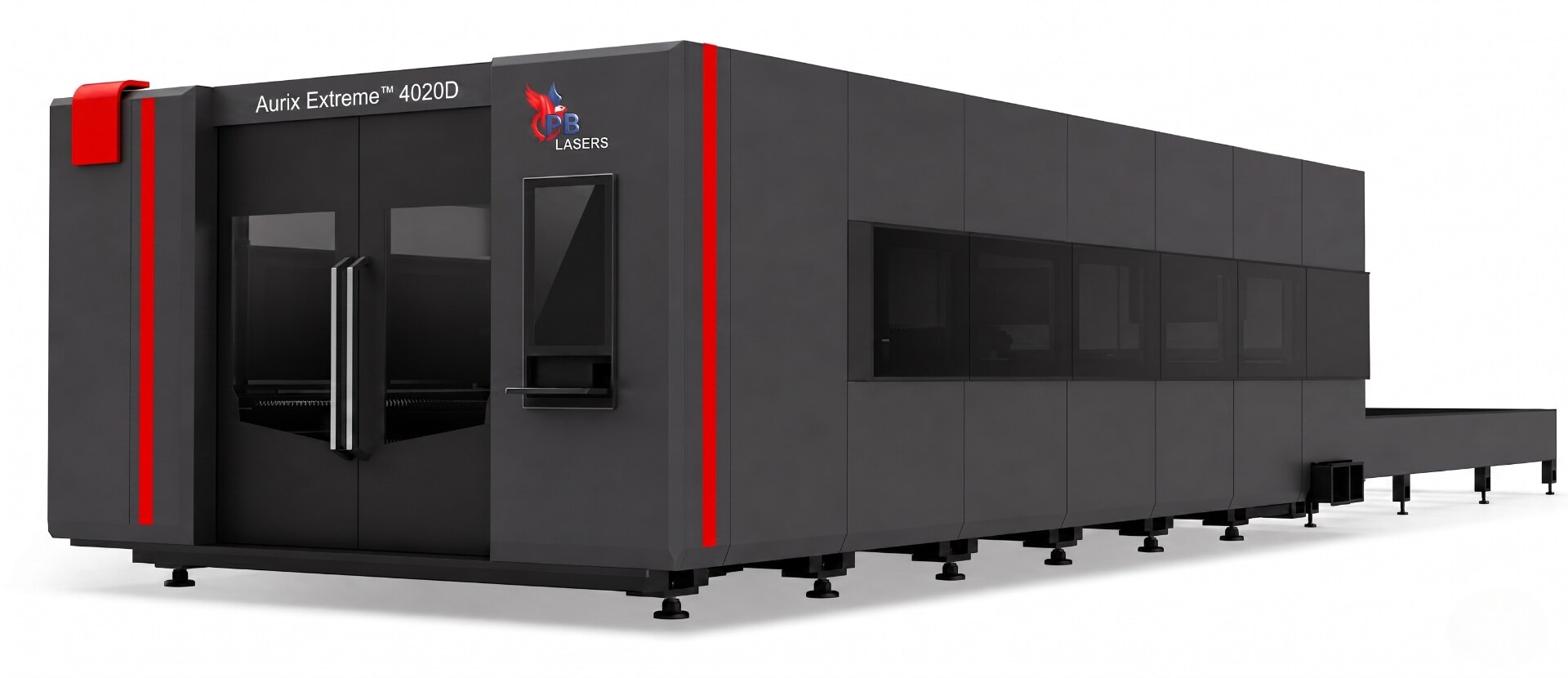
A 5'×10' (3015) bed is the entry point for sheet work. Step up through 6'×13' (4020) to 8'×24' large-format beds and the price climbs with the structure. A laser frame that holds tolerance over 24 feet is a serious piece of fabrication.
Tube capability
Tube lasers price by format more than power: chuck count, maximum tube length, and loading automation are the big levers. A single-phase entry tube laser and a 60-foot 3-chuck industrial line are different investments entirely. A combo (sheet + tube) machine is the most economical way to get both capabilities in one footprint.
Automation
A storage tower and load/unload system adds to the invoice but changes the return completely. It's the difference between a laser that cuts while someone stands there and a laser that runs lights-out overnight. Automation is why two shops with the same machine post very different numbers.
Three Price Tiers. Three Very Different Deals.
The big names: premium price, premium overhead
Excellent machines. But a meaningful slice of the price is the booth at the trade show, the sales structure, and the service ecosystem you'll be living inside afterward. You pay going in, and you keep paying.
The cheap imports: low sticker, high exposure
The sticker is real; so is the risk. Roughly half the machine weight of a production-class frame, mixed-supplier internals, and troubleshooting across an ocean at 2 a.m. The purchase price is the cheapest part of owning one.
PB Lasers: production-class, about half the big-name price
Built to roughly double the weight of many same-class imports, UL-listed Schneider electronics, engineer-led installation until your team is producing, at about half of what the big names charge for comparable capability. Not the cheapest machine on the market. The cheapest machine to own.
Stop Comparing Machines to Machines. Compare the Machine to a Hire.
On a lease-to-own, an AURIX™ 3015 sheet laser costs roughly twenty-one to twenty-eight dollars an hour on a standard work month. A machine operator costs twenty-five, thirty, thirty-five dollars an hour, and calls in sick, takes vacation, and needs benefits.
Already outsourcing laser cutting? Then you probably already have a free laser: in our experience, the outside-processing checks you're writing almost always cover the lease payment. That's not a new cost. It's a reallocation, from someone else's machine to your own asset.
And Section 179 lets most US shops write off the full purchase price in the year of delivery. Every payment is deductible the way your rent is.
The question was never 'can I afford the laser.' It's 'how much longer can I afford to pay other people to own one.'
The Questions Every Buyer Asks.
An industrial fiber laser cutting machine ranges from the low six figures for an entry-level sheet machine to well over a million dollars for a high-power big-name flagship. The spread is driven less by cut quality than by power (kW), bed format, tube capability, automation, and, above all, whose business model is attached to the machine. PB Lasers machines run roughly half the price of the big names for comparable production capability.
Tube lasers span a wider range than sheet machines because format drives the price: a single-phase entry-level tube laser is a fraction of the cost of a 60-foot, 3-chuck industrial line. Chuck count, loading automation, and maximum tube length move the price more than laser power does. We size the machine, and the budget, on an engineering call.
Because you're not paying for a twenty-million-dollar trade show budget, a service-contract profit center, or a proprietary-parts ecosystem. We don't carry the big names' overhead, so you don't pay for it. The machine itself is built heavier than most machines in its class, with UL-listed Schneider electronics.
Consumables (nozzles and protection lenses), assist gas, electricity, and routine maintenance. With PB Lasers, the first year of consumables is included, the nesting/CAM software is permanently licensed with no subscription, and there is no required service contract. Three of the largest hidden costs in big-name ownership are removed up front.
In the US, Section 179 lets most shops write off the full purchase price of qualifying equipment in the year they take delivery, and lease payments are typically deductible as an operating expense. Confirm specifics with your accountant.
On a lease-to-own, an AURIX™ 3015 sheet laser runs roughly twenty-one to twenty-eight dollars an hour on a standard work month, less than most shops pay a machine operator. If you're currently outsourcing laser cutting, that outside-processing spend usually covers the payment on its own.
Exact Pricing Takes One Call. Because Sizing Comes First.
Our mission is to bring productivity back to North American manufacturing.
Honest pricing is part of how we get there.